
Each year, the Massachusetts Institute of Technology receives nearly 20,000 applications from high school hopefuls. Only 8% of them get a MIT acceptance letter.
For example, in 2014, MIT accepted 1,447 applicants from 18,356 candidates. That’s a small 7.9% admission rate.
Unfortunately, the overwhelming majority of applicants get a rejection letter. “I'm very sorry to inform you…”
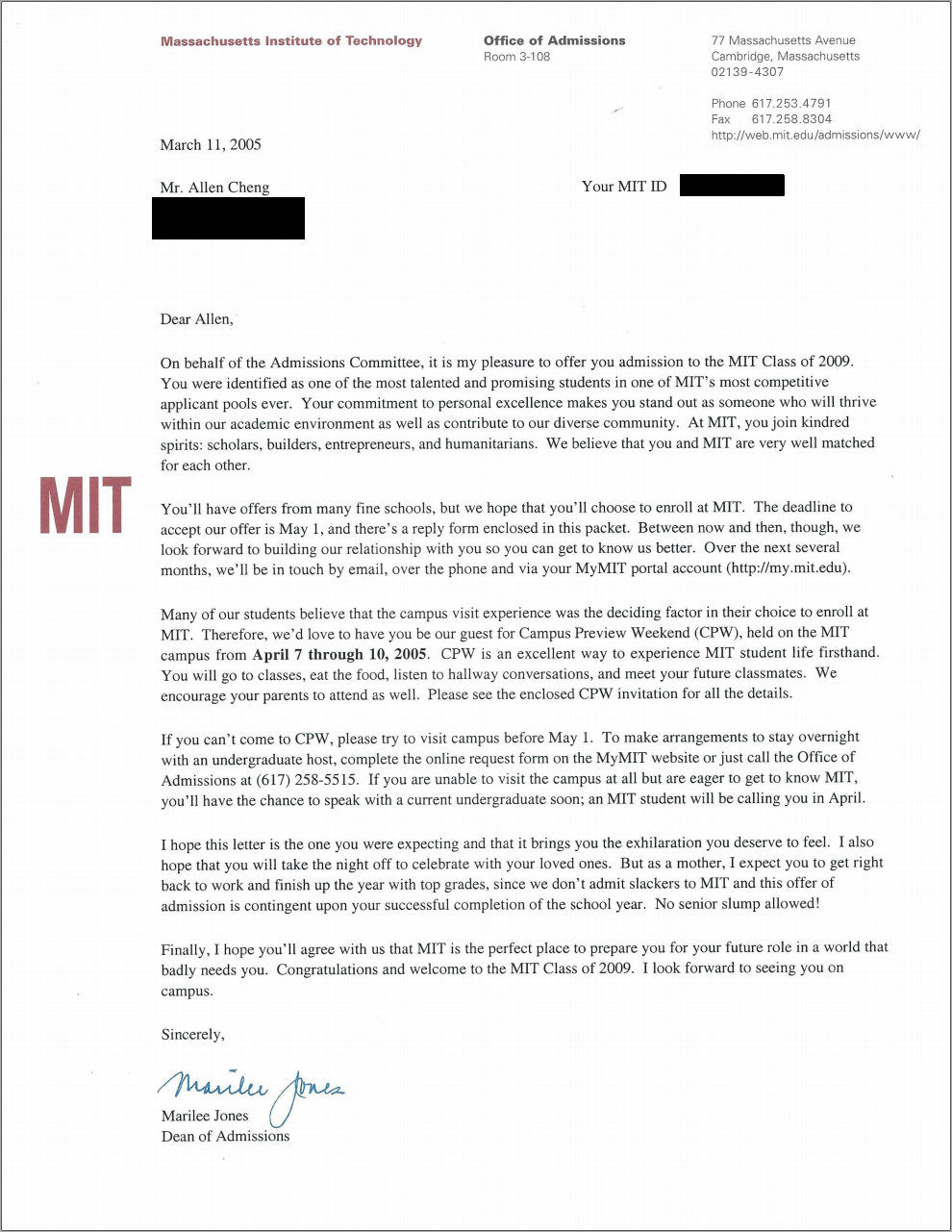
When I was in high school, I was one of the lucky few to apply to MIT and receive an acceptance letter in the mail. This validated years of hard work, especially in the sciences and research. It was inspiring to know that they wanted me to be a part of their amazing community.
Here’s my complete, official MIT acceptance letter.

Did you know that almost half of all undergrads in the U.S. go to community college? In fact, there are 1,100 community colleges nationwide, and they enroll 13 million students!
If you're looking to make that 13 million and one, read on to learn how to apply for community college: from deciding where to apply to enrolling in classes. Before getting the ball rolling, let's review what community colleges offer their students and some good reasons to apply.
If you've applied to colleges, received acceptances, and selected the college you want to attend, then congratulations! You've done considerable work and made it through the college application and selection process. With May 1, also known as College Decision Day, just around the corner, how do you notify the college you've selected that you'll be attending? How do you let the other colleges that admitted you know that you won't? Do you even have to let them know?
In this article, I'll explain how to accept an offer of admission and why it's important to notify the colleges you won't be attending of your decision.
You’ve probably felt the pressure to go on college tours, but just how important are they? Are they an essential part of the college planning process, or is it not a big deal if you opt out?
This guide will go over the most important reasons to visit a college, along with some circumstances when you might choose not to tour. We’ll also discuss how you can prepare to make the most out of your college visits.
First off, what are some reasons you should tour your prospective colleges?
You’ve been working hard in high school to get good grades and test scores, but there’s another part of the college application that many students find more confusing: the extracurricular activity section.
How many extracurricular activities do you need for college applications? How many are too many? Will you get rejected from a school if you don’t have the right amount?
Many students who have participated in activities throughout high school are shocked to look at the Common App and realize there are ten spaces to fill out. Does that mean you have to be involved in ten different activities?
In this article I will tell you:
- The important things colleges need to see in your extracurriculars
- The ideal amount of extracurricular activities
- The minimum amount of extracurriculars you can have
- What to do if you have no extracurriculars
- What to do if you have too many extracurriculars
The college application process can be a long and difficult journey for high school students. Organizing your application materials well in advance and paying attention to deadlines is critical. You should also start researching colleges earlier rather than later so that you can account for each school's specific application requirements.
In this infographic, I've broken down the actions you need to take to be prepared for college applications starting at the beginning of your junior year through to your senior spring.
Forbes is a highly respected source of college rankings and is often consulted by students to help them decide which colleges are objectively the “best” choices. However, relying too much on these rankings can be a dangerous way to go about the college search process. In this article, I’ll outline how Forbes rankings are calculated and give you a rundown of the problematic aspects of these rankings.
Since the U.S. News & World Report college rankings list debuted in 1983, college-bound students and their parents have become quite enamored with college ranking lists. While the U.S. News list may be the most well-known, there are a plethora of college ranking lists out there. All use slightly different criteria to rank colleges and all claim to be the best and most reliable. However, should you trust any of these lists? Should you use them when deciding which college to attend? Do they provide any valuable information?
In this article, I'll answer those questions. I'll let you know how much you can trust college ranking lists. Furthermore, I'll explain the pros and cons of these lists and how to use them to your benefit.
Colleges generally say that they don’t have strict ACT score requirements. However, if you get a low ACT score, your chances of gaining admission to a selective college could be slim to none. There is no specific ACT score requirement to be admitted to the school of your dreams, but your ACT score will increase or decrease your likelihood of getting in.
In this article, I will discuss ACT requirements for college and how to determine your target ACT score to help you reach your college goals.
What Is a Reach School? Which Reach Schools Should I Choose?
For those of you who have started researching college admissions, you may have heard the term “reach school.” What is a reach school? Simply, a reach school is one that you shouldn't expect to be admitted to. It would be a reach to get in.
In this article, I will define and explain the concept of a reach school. Furthermore, I will discuss how to identify your reach schools and determine the number of reach schools you should apply to.
Complete Expert Guide: How to Make an Art Portfolio for College
Are you thinking about applying to an art program? Do you know what you should include in your portfolio? Your art portfolio is usually the most important part of your application, and having a great one can significantly improve your chances of getting into your top schools.
How Does College Athletic Recruiting Work? The Complete Process
If you are a high school athlete who aspires to compete in college sports, you should know about the college athletic recruiting process. Even if you don’t end up getting a scholarship, many intercollegiate athletes who don’t receive aid are still recruited to participate in sports at the collegiate level. The college recruiting process can be confusing. There are tons of recruiting rules that vary by division and the process for each prospective student-athlete can be extremely different.
In this article, I’ll explain the various steps of the college recruiting process. I’ll provide important advice for prospective student-athletes so that you’re able to reach your collegiate and athletic goals.
If you’re a big fan of college sports, you may have seen a news conference on ESPN where a highly recruited high school athlete announces what college he is going to attend (usually in a dramatic way), and then he signs a piece of paper. That piece of paper is his National Letter of Intent; he is now legally bound to attend that college and the recruiting process is officially over.
I remember the day I signed my National Letter of Intent to attend Stanford. I don’t think my mom has ever been as proud, and it’s very likely I won’t ever make her that proud again. Receiving and signing a National Letter of Intent is your reward for years of hard work and signifies the culmination of your college search.
In this article, I will explain what the National Letter of Intent is, why it exists, and its terms.
While you may end up deciding to apply to a mixture of public and private colleges, you should be aware that each type has its own general set of characteristics that may be more or less aligned with your preferences. Which type of school is cheaper? Which colleges are bigger, and what opportunities exist in private vs public universities?
In this article, I’ll discuss the differences between public and private colleges that you should consider in your search.
In-state colleges can be great options if you live in a state with a strong university system. But what are the positives and negatives of these schools, and is an in-state school the right choice for you?
I’ll go through the pros and cons of attending an in-state college, give you some examples of schools that fit this mold, and help you figure out if you should go.